Most people spend more time researching a new phone than they do a mattress. Then they lie awake at 2 a.m., back aching, wondering why the thing they sleep on every night for the next decade got less than an hour of their attention. A bad mattress is one of those purchases you don’t fully regret until it’s too late to do much about it — the return window has closed, the showroom salesperson has moved on, and you’re left negotiating with a sag in the middle.
The store itself matters as much as the mattress on the floor. A good mattress store will give you the time, the information, and the conditions you need to make a sound decision, not just the fastest path to a checkout. Here are six things worth checking before you commit to anything.
How the Staff Handles Your Questions
Walk in with a simple, open-ended question: “I’m a side sleeper with some lower-back tension. Where would you start?” The answer tells you almost everything. A knowledgeable salesperson will ask about your weight, your preferred sleeping position, whether you share the bed, and how warm you tend to sleep before they point you anywhere. Someone who leads with the most expensive model on the floor, or who can’t explain the difference between a pocket coil and a foam core, is selling on commission, not expertise.
Mattress construction has a direct effect on how long a mattress supports you correctly. High-density foam at 1.8 pounds per cubic foot or above holds its shape considerably longer than the cheaper 1.5-pound alternatives stuffed into entry-level builds. A salesperson who can explain that distinction and explain why it matters for your body weight and sleep position is worth listening to. One who can’t is a reason to keep looking.
Whether You’re Encouraged to Actually Lie Down
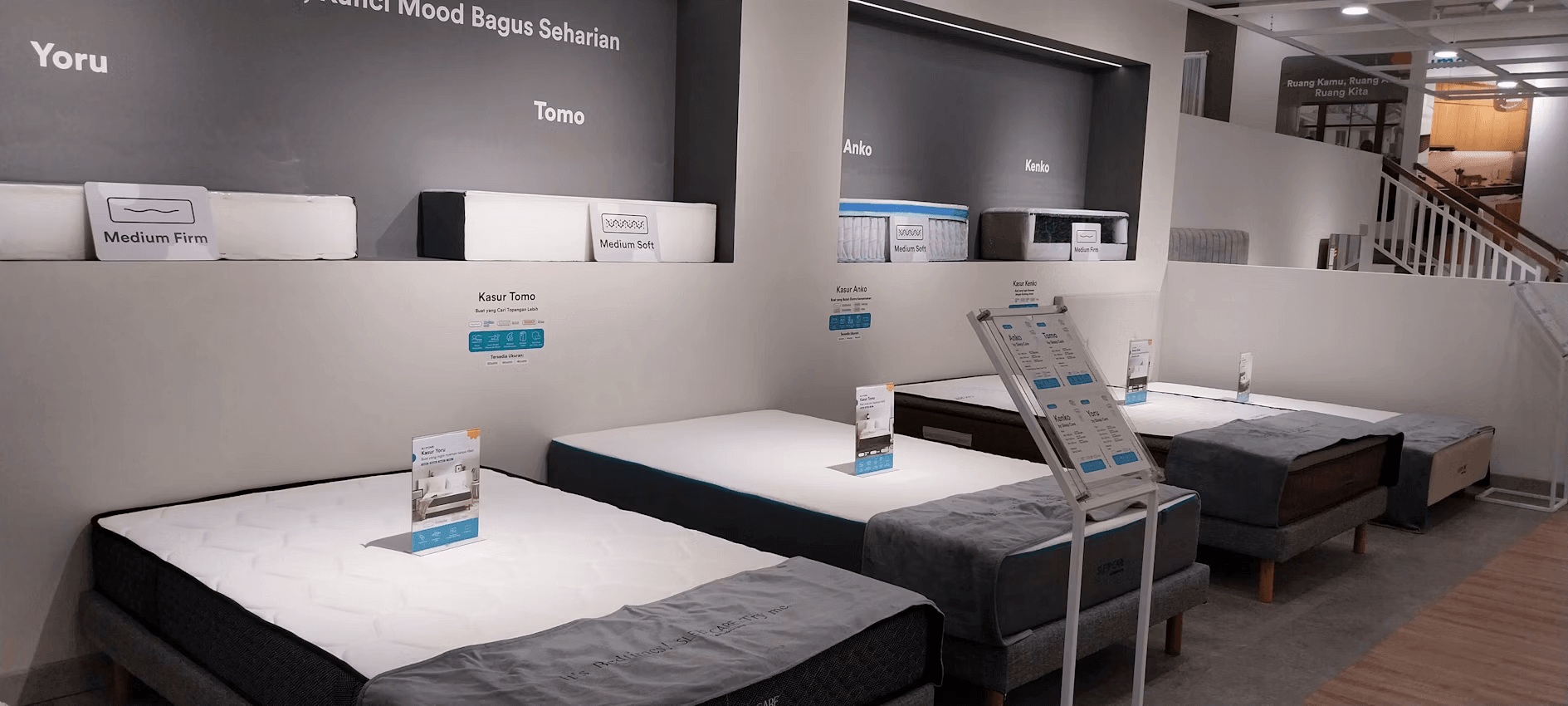
A mattress you’ve tested for thirty seconds while wearing a winter coat tells you almost nothing. Your body needs a minimum of ten minutes in your actual sleep position side, back, stomach, or the chaotic combination of all three before it gives you an honest read on support and pressure relief. If the staff hurries you along, discourages testing more than one or two models, or seems visibly impatient while you’re lying there, the store is optimising for throughput rather than your comfort.

Pay attention to what happens at the shoulders and hips when you’re on your side. Those two points carry most of your weight on a firm surface, and if a mattress is too stiff, you’ll feel a concentrated pressure there within a few minutes. A mattress with decent zoned support is firmer under the hips, softer under the shoulders, as side sleepers need distributes that load more evenly. Ask which models in your budget offer that. If no one can answer, that’s useful information too.
Reading the Trial Period and Return Policy
Your body takes time to adjust to a new sleep surface typically two to four weeks before the novelty wears off and you’re getting an accurate sense of how rested you actually feel. A trial period shorter than thirty nights doesn’t give you that window. The better stores offer ninety to a hundred and twenty nights; some extend to a full year. Anything under thirty nights is worth questioning, and a store with no trial period at all is a firm signal to walk.
Read the fine print before you assume the return is straightforward. Many policies charge a collection fee, require the mattress to be in pristine condition, or exclude certain mattress types hybrids and latex models are common exclusions. A few policies will exchange for store credit rather than a full refund. None of this is necessarily a dealbreaker, but knowing the terms before you buy is considerably better than discovering them when you want out.
Checking the Warranty Before You Trust the Salesperson’s Word
Mattress warranties look generous on paper until you read how they define a defect. Most cover manufacturing faults and visible sagging, but the sag threshold, the point at which the brand acknowledges something is wrong, varies widely. A warranty that only kicks in at 1.5 inches of body impression is far less useful than one that covers anything over three-quarters of an inch, because by the time you’ve sunk an inch and a half, you’ve already been sleeping badly for months.
Ask specifically: what voids this warranty? The two most common answers are an unsupported base (many warranties require a specific slatted frame with gaps no wider than three inches) and any visible stain, including water marks. The second condition catches a lot of people off guard; a single spill, no matter how minor, can be enough to void coverage on a mattress costing over a thousand dollars. A good store will tell you this upfront. One that glosses over it is hoping you don’t ask.
Mattress store checklist (original)
| What to look for | Why it matters | Quick check | Red flag |
| Frame quality | Determines lifespan of the mattress | Ask about materials used | Cardboard or staple corners |
| Trial period | Lets your body adapt before committing | 30 nights minimum; 90–120 is better | No returns at all |
| Staff knowledge | Helps narrow choice to your sleep style | Ask about firmness and support layers | Only pushes highest-margin model |
| In-store testing policy | Lying for 10+ min gives honest read | Are you encouraged to try multiple? | Rushed or discouraged testing |
| Delivery & setup | White-glove matters for heavy mattresses | Confirm setup and old-mattress removal | Delivery only, no setup included |
| Warranty terms | Protects against defects and sagging | Check sag threshold (usually ¾ to 1 in) | Warranty voided by any stain |
What the Delivery and Setup Terms Actually Cover
A king-size hybrid mattress can weigh well over a hundred pounds. Getting it from a truck to a second-floor bedroom without damaging the mattress, the walls, or your back is not a trivial exercise. White-glove delivery where the crew brings the mattress inside, sets it up on your frame, and removes your old one is worth paying for if the alternative is managing it yourself. Ask whether that service is included, what it costs if it isn’t, and whether there’s a fee for removing your existing mattress.
Also confirm the lead time. A mattress ordered in-store can take anywhere from two days to six weeks to arrive depending on the model and the store’s supply chain. If you’re replacing a mattress that’s already past the point of comfort, that gap matters. Some stores keep a selection of models in stock for next-day or same-week delivery; others are custom-order only. Neither model is inherently better, but knowing which one you’re dealing with before you sign anything saves a frustrating conversation later.
Whether the Price Reflects the Build or Just the Brand
A higher price tag does not automatically mean a better mattress. Some brands carry a significant premium for name recognition alone, while others often sold through smaller or mid-size retailers offer comparable construction at a lower price point. The number to ask about is the coil count on innerspring and hybrid models: a quality queen-size hybrid typically runs between eight hundred and a thousand individually wrapped pocket coils. Below six hundred, the support starts to feel uneven, particularly near the edges though that threshold can shift depending on the coil diameter and construction.
For foam and latex models, the density figures matter more. High-resilience polyfoam at 2.0 pounds per cubic foot or above holds up well; anything below 1.5 pounds is likely to soften and indent faster than the warranty threshold will ever acknowledge. A store that can tell you these numbers without you having to ask twice is a store that knows what it’s selling. One that deflects to vague terms like “premium comfort layers” is giving you marketing language instead of information.
The Store as Part of the Decision
No mattress makes sense in isolation from the conditions under which you chose it. A good store gives you accurate information, reasonable time to test, honest policy terms, and staff who understand what they’re selling well enough to explain it clearly. A bad one rushes you, obscures the return policy, and can’t answer a direct question about construction. The mattress on the floor is important, but so is the environment in which you’re evaluating it. Walk out of any store where the experience itself feels like a pressure tactic.
FAQ
How long should I spend testing a mattress in-store?
At least ten minutes in your actual sleep position per model you’re seriously considering. Your body needs time to register how pressure is distributed across the shoulder and hip points. A thirty-second sit on the edge tells you almost nothing.
What firmness level is right for a side sleeper?
Most side sleepers do well in the medium to medium-soft range, roughly a 4 to 6 on a 10-point scale. That range allows the shoulder and hip to sink in slightly while the spine stays aligned. If you’re above 200 pounds, lean toward the firmer end of that window.
Is a longer trial period always better?
Generally, yes ninety to a hundred and twenty nights is the most useful window. Your body takes two to four weeks to adjust to a new surface, so anything under thirty nights doesn’t give you a fair read. Read the return conditions carefully regardless of length, since some policies charge fees or limit returns to exchanges.
Do I need a special bed frame for a new mattress?
Check the warranty requirements before you assume your existing frame qualifies. Many warranties require a slatted base with gaps no wider than three inches, or a solid platform surface. Using an unsupported or widely-spaced slat base can void coverage on an otherwise solid mattress.
What does white-glove delivery actually include?
Typically: delivery to your room, setup on the frame, and removal of your old mattress. Not all stores include every component in the base price, and removal fees for old mattresses vary. Ask for a written breakdown before you finalise the order.
When you’re ready to compare options in person, browsing a curated selection at a reputable mattress store gives you a chance to apply all of the above with staff you can actually question, and policies you can read before anything is signed.