A visit to Versailles is one of the easiest and most rewarding family day trips from Paris. Located about 12 miles southwest of the city, Versailles is best known for its famous palace, but there’s much more to explore than a quick walk through the Hall of Mirrors.
From sprawling gardens and playful fountains to hidden villages and royal retreats, the estate offers plenty of space for families to slow down, wander, and discover history together.
Here are seven experiences worth adding to your Versailles itinerary.
Walk Through the Hall of Mirrors
The Hall of Mirrors runs 240 feet down the palace’s west side, lined with 357 mirrors reflecting 17 arched windows that overlook the gardens. It was built in the 1680s to show off France’s mirror-making skill at a time when Venice held a monopoly on the technology.
This is also where the Treaty of Versailles was signed in 1919, ending World War I, so the room carries as much political weight as visual drama. Arrive right when the palace opens or in the last hour before closing to see it without shoulder-to-shoulder crowds.
Tour the King’s and Queen’s State Apartments
Beyond the Hall of Mirrors, the State Apartments show how differently the king and queen lived within the same court. Louis XIV’s rooms are arranged around a strict daily ritual, the lever and coucher, where nobles competed for the honor of watching him wake and dress.
Marie Antoinette’s apartments, by contrast, reflect her attempts to carve out privacy, including a private theater and a hidden door she used to escape court life. Touring both sides gives a clearer sense of Versailles Palace as a working court, not just a museum piece.
Get Lost in the Gardens
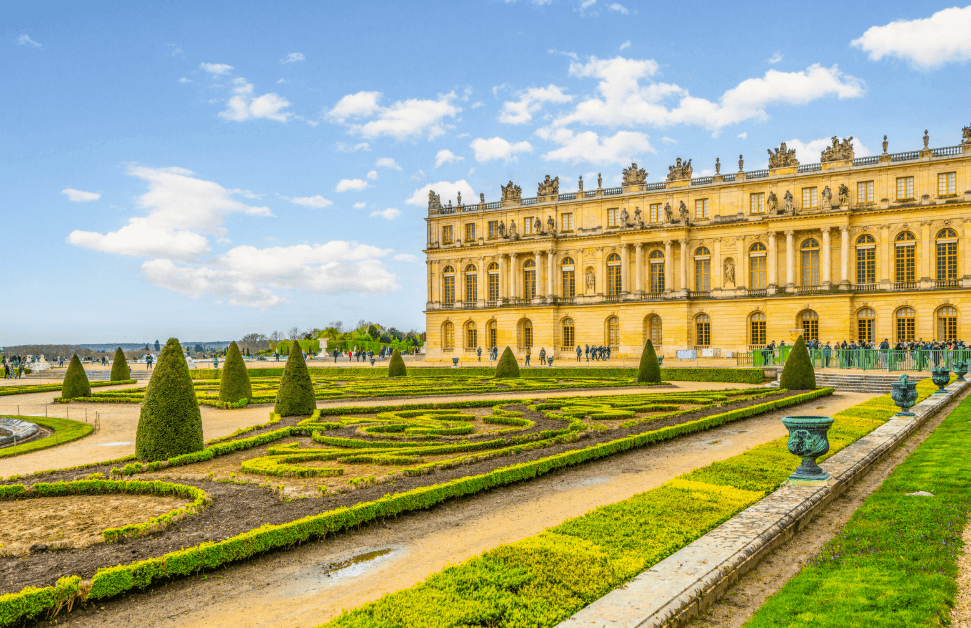
André Le Nôtre designed the gardens as a geometric counterpart to the palace’s grandeur, and they cover roughly 800 hectares, larger than some small towns. Formal parterres, tree-lined paths, and more than 50 fountains fan out from the palace’s rear terrace.
Budget at least two hours if you want to walk as far as the Grand Canal, where rowboats are available to rent in warmer months. Comfortable shoes matter more here than almost anywhere else in the visit.
Catch the Musical Fountain Shows
On select days from spring through fall, the gardens’ fountains run in choreographed sequence to Baroque music, a show called Les Grandes Eaux Musicales. Louis XIV commissioned similar fountain displays for his own entertainment, and the modern version uses the same hydraulic logic engineers worked out centuries ago, since Versailles has no natural water source and relies on a network of pumps and reservoirs.
Check the show schedule before visiting, since fountains only run on specific afternoons, not every day. Standing near the Latona Fountain when the water first surges up is worth timing your visit around.
Visit the Grand Trianon and Petit Trianon
Set apart from the main palace, the Trianon estate gave French royals a retreat from formal court life. The Grand Trianon, built for Louis XIV, is a low pink-marble palace designed for informal visits with mistresses and close family.
The Petit Trianon later became Marie Antoinette’s personal domain, a gift from Louis XVI that she redecorated entirely to her own taste. Both buildings are a 25-minute walk from the main palace, or a quick ride on the little tourist train, and they see far fewer crowds than the main château.
Explore the Queen’s Hamlet
Just beyond the Petit Trianon, Marie Antoinette had an entire rustic village built for her amusement, complete with a working farm, a mill, and thatched-roof cottages. It was finished in 1783 as a place where she could play at simple country life, dressing in plain muslin gowns and tending to real livestock.
The buildings look convincingly aged, though at the time they were brand new construction meant to look weathered. It is one of the more surprising corners of the estate, and one many day-trippers skip entirely because it sits at the far edge of the grounds.
Time a Visit Around the Royal Opera House
The Royal Opera House, inside the palace’s north wing, is one of the largest theaters of its era and was completed in 1770 for the marriage of the future Louis XVI to Marie Antoinette. Its wooden structure gives it unusually warm acoustics, and the interior is done almost entirely in painted wood made to look like marble, a cost-saving trick that still fools most visitors.
Access is limited and sometimes requires a separate ticket or guided tour, so check current opening hours before planning around it. Seeing it adds a sense of scale that photographs of the Hall of Mirrors don’t quite capture.
Conclusion
Versailles is a destination that rewards slowing down, especially when you’re exploring with family. Rather than rushing to see everything, pick two or three highlights that match your group’s interests and leave time to wander the gardens, enjoy a picnic, or simply take in the scenery. With a little planning, a visit to Versailles can become one of the most memorable family experiences during your time in France.
0
Leave a Reply