A child riding in the front seat is simply exposed to more risk than most parents realize. It is not just about age. It is about how a vehicle is designed, how crash forces behave, and how children’s bodies respond differently in impact situations.
In many places, parents quietly ask a practical question, “How old do you have to be to sit in the front seat?” without fully understanding that the answer is less about a number and more about safety structure. The truth is, even when a child “looks big enough,” the front seat still carries risks that do not disappear with size alone.
Most safety guidance from agencies like the National Highway Traffic Safety Administration leans heavily toward keeping children in the back seat until they are at least 13. Not because of tradition, but because of how crash dynamics actually play out in real life.
Danger 1: Airbag Deployment Can Cause Unexpected Injury Risks
Airbags are not soft cushions. They deploy with explosive force in milliseconds, designed to protect adults sitting at a specific distance and posture. For children, that timing and force can feel completely unforgiving.
Even a properly seated child can be too close to the dashboard at the wrong moment. That’s the part people underestimate. The bag does not “know” comfort or intention. It reacts to physics.
According to the National Highway Traffic Safety Administration, airbags deploy at speeds faster than the blink of an eye and can cause injury or even fatal harm to children sitting too close to the dashboard.
It is also worth noting that federal safety rules under 49 CFR §571.208 (FMVSS No. 208) were designed primarily around adult occupants. That gap matters more than people think.
Danger 2: Seatbelt Mismatch That Fails to Protect Children Properly
Seatbelts are supposed to save lives, but only when they fit the body they are meant for. In children, they often don’t.
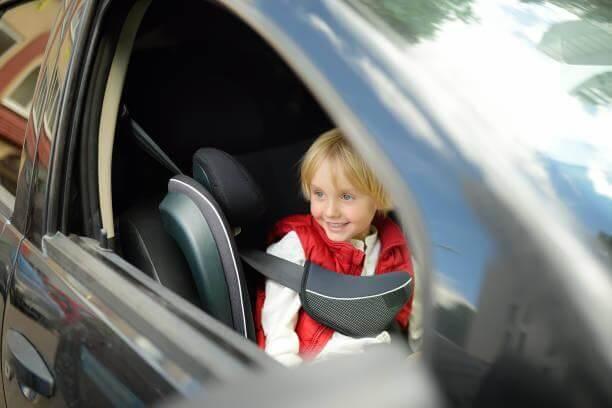
The lap belt can ride up on the stomach instead of sitting on the hips. The shoulder strap may cross the neck instead of the chest. It looks “secured,” but the protection is not working the way it should.
In a crash, that mismatch can lead to internal injuries that are not visible right away. And that delay is part of what makes it so dangerous.
Danger 3: Proximity to the Crash Zone Increases Injury Severity
Sitting in the front seat places a child closer to the hardest impact areas of the vehicle: dashboard, windshield, airbag housing; all of it.
When a crash happens, the forward movement is sudden. There is very little space to absorb that motion in the front seat compared to the rear.
Even low-speed collisions can become serious when there is no buffer zone. The back seat naturally gives that extra distance. The front seat does not.
Danger 4: Adult Safety Systems Are Not Designed for Children
Car safety systems are built around adult bodies. Not children who are still growing and changing shape.
Under FMVSS No. 208 (49 CFR §571.208), occupant protection systems are calibrated using adult-sized crash test dummies. That includes airbag timing, seatbelt force limits, and sensor response systems.
So when a child sits in that space, the system is doing its job, just not for their body type. It is a quiet mismatch. Nothing obvious on the surface, but important underneath it all.
Danger 5: Unsafe Seating Habits That Increase Accident Risk
This is where behavior starts to matter more than hardware. Children in the front seat tend to lean forward, adjust themselves often, or sit in awkward positions without realizing the risk.
Research from the IIHS shows that properly used rear seats reduce the risk of fatal injury for child passengers by around 30% compared to front-seat placement.
Small habits add up, such as a seatbelt worn incorrectly, a moment leaning forward, and distraction in traffic. None of it feels serious until it is.
Key Takeaways
- Airbags deploy too forcefully for smaller bodies.
- Seatbelts often do not fit children correctly.
- The front seat sits directly in the crash zone.
- Safety systems are calibrated for adults.
- Behavior in the front seat increases exposure to risk.
Leave a Reply