There was a moment when working from home felt like the answer for busy families. No commute. More flexibility. More time at home with your kids. It sounded like the perfect setup.
But a few years in, many parents are finding something different. Working from home does not always protect parents from burnout. In many cases, it brings work stress and family responsibilities into the same space, making it harder to manage both.
When your office and your home share the same walls, it becomes harder to separate your roles. You are answering emails while helping with snacks, thinking about deadlines during bedtime, and trying to be present while your attention is split. Instead of creating balance, it can leave parents feeling stretched thin all day.

Why a Healthy Work-Life Balance Matters More Than Ever
Most people think of work-life balance as a perfect split. Half work, half life. That is not how it works in real life.
What actually helps is separation. You need some kind of boundary between work and home. It can be physical, like leaving the office, or mental, like having a short break before you walk through the door. That space helps your brain shift from work mode to parent mode.
When that separation disappears, stress builds up quickly. It does not come in slowly. It piles on. The American Psychological Association reported in 2023 that many burned-out workers deal with physical symptoms like headaches, stomach issues, and constant fatigue. Those numbers likely do not capture the full picture, especially for parents who are juggling both roles at once.
This is where working from home becomes tricky. Being at home makes it seem like balancing work and family life should feel easy. But instead, everything blends together. You are checking messages while cooking dinner. You are in a meeting while your child asks for help. Your attention is split, and neither role gets your full focus.
From the outside, it can look like a great setup. But inside the home, it often feels very different. That is one reason working from home does not always protect parents from burnout. It can be hard to even recognize what is happening.
Long term, work-life balance often becomes harder, not easier.

Long-term, work-life balance actually gets harder.
The Hidden Ways Remote Work Fuels Burnout
One thing many parents do not expect to miss is the commute. Not the traffic, but the quiet time in between.
That time used to help you reset. It gave your brain a chance to move from work mode to home life. Without it, the shift happens instantly.
One moment you are looking at a spreadsheet. The next, your child is asking for a snack. That transition used to take time. Now it happens in seconds.
Then there is the laptop. It stays nearby all evening. It is easy to open it after dinner just to check one thing. Microsoft reported in 2022 that remote workers often work longer hours than before, putting in 46 extra minutes per day. What feels like a few extra minutes can quickly turn into lost time with your family.
Even small things add pressure. A messy kitchen during a meeting. Laundry waiting in the background. At an office, those things are out of sight. At home, they compete for your attention all day.
Protect Parents From Burnout: The Guilt Spiral Parents Can’t Escape
Guilt is often the hardest part of all this.
Your child asks for help during a meeting, and you tell them to wait. That feels bad. The next day, you step away from work for a school event and wonder if your manager noticed. It can feel like you are always letting someone down.
This kind of guilt is different. Parents who work outside the home often feel guilty for not being there. Parents who work from home feel guilty even when they are there.
You are in the next room, but your child still feels ignored. That is a heavy feeling to carry every day.
Working from home does not protect parents from burnout when that emotional gap keeps growing. Being physically close is not the same as being fully present.
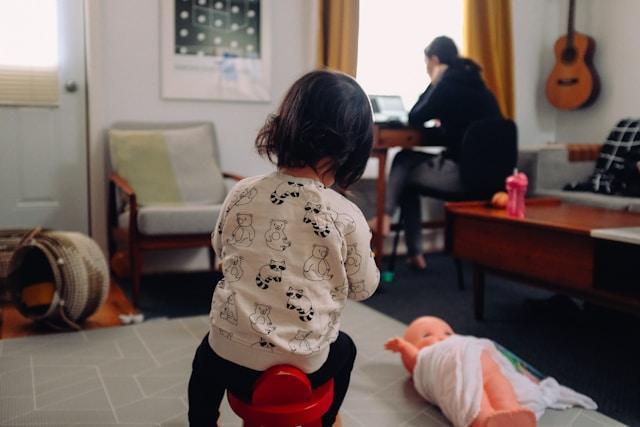
Parents often feel guilty about not being with their kids, even though they’re technically at work.
Recognizing the Warning Signs
Burnout does not always show up in obvious ways.
At first, it just feels like being tired. You might think you need better sleep or need a vacation.
But the feeling does not go away. You find yourself snapping at your child over small things. Work starts to feel harder than it used to. Even the weekend does not help you reset.
There are physical signs too. Frequent headaches. Trouble sleeping. Changes in appetite. That restless feeling where your mind will not slow down.
One of the clearest signs is going through your routine without really being present. Bedtime becomes a checklist. Bath, teeth, story, lights. Later, you realize you do not remember what your child said about their day.
This does not mean something is wrong with you. It usually means the way your day is set up is not working.
Practical Strategies to Push Back Against Burnout
So what can actually help?
Start with physical separation. If you have a room with a door, use it as your workspace. If not, create a small boundary with a table, a shelf, or even a screen. This helps your brain understand when you are working and when you are not.
Set a clear end to your workday. Choose a time to recharge your mind and body and stick to it. When that time comes, close your laptop and step away. Do not add one more task. Let the day end.
It also helps to make that boundary visible to others. Let your manager and your family know your work hours. Without that clarity, work can slowly take over your evenings.
And then there is something many parents skip. Time for yourself.
This does not mean chores or errands. It means time that is not tied to being productive. A short walk. Reading a few pages of a book. Sitting outside for a few minutes.
You cannot protect parents from burnout by trying to fit more into the same day. Sometimes the only solution is to take something off your plate.
Final Thoughts
Working from home or a condo is not the problem on its own. For many families, it is still the best option. But it only works well when there are clear boundaries between work time and family time.
Being home with your kids is not the same as being present with them. Parents need space to focus on work and space to fully step into family life. Without that separation, it becomes easy to feel like you are falling short in both areas.
Take a step back and look at what your daily routine really feels like. If you are constantly tired, distracted, or running on empty, it may be time to adjust how your days are structured. Small changes in boundaries and expectations can make a big difference for both you and your family.
0
Leave a Reply