• Skip to primary navigation
  • Skip to main content
  • Skip to primary sidebar
  • Skip to footer

Whipperberry

WhipperBerry • Your Home For Creative Inspiration

  • Home
  • Recipes
    • Starters
    • Easy Weeknight Dinners
    • Main Dish
    • Salads
    • Side Dish
    • Soups & Stews
    • Desserts
    • Breakfast
    • Miscellaneous
  • Tutorials
    • Creative Crafts
    • DIY Decor
    • Fabric Crafts
    • Food How-To
    • Jewlery
    • Paint Projects
    • Paper Art
    • Party Styling
    • Photography and Graphic Design
    • Silhouette
  • Holidays
    • Easter
    • Mother’s Day
    • Father’s Day
    • 4th of July
    • Halloween
    • Thanksgiving
    • Christmas
    • Valentine’s Day
  • Gift Ideas
    • Gifts For Everyone
    • Gifts for Dad
    • Mother’s day
    • For The Girls
    • For The Kids
    • Teacher Gift Ideas
    • Christmas
  • Printables
    • Holiday
    • Gift Idea
    • LDS Primary
  • Travel
  • About
    • Terms
  • Contact
  • Nav Social Menu

    • Facebook
    • Instagram
    • Pinterest
    • RSS
    • Twitter

Health & Wellness

Assisted Living for Couples With Different Care Needs

0 · Apr 6, 2026 · Leave a Comment

Growing older together is one of those quiet promises couples never actually say out loud. Then one partner gets a dementia diagnosis, and suddenly the question isn’t about growing old together anymore. It’s about whether “together” is even still possible.

That fear of separation is something families carry into every tour, every phone call, every intake meeting. Most of them don’t realize until they’re already deep in the search that some communities have been built specifically around this problem.

Tiered care programs and connected specialized wings now make it possible for couples to stay on the same campus even when their needs look nothing alike. For families looking at options in South Florida, Assisted Living in Aventura has become a recognized model for this kind of paired approach. Here, one spouse can receive memory care while the other lives in a standard assisted living setting, both within the same community.

When Care Needs Diverge

It’s more common than most people expect. The Alzheimer’s Association estimates that over 6 million Americans are living with Alzheimer’s disease. And in the majority of those cases, a cognitively intact spouse is quietly absorbing the bulk of daily caregiving at home. That arrangement works until it stops working.

When the weight becomes too much, families face a real bind. A skilled nursing facility is often too clinical for the healthier spouse. A standard assisted living community typically isn’t equipped for someone with moderate-to-severe cognitive decline. Historically, that mismatch has meant one thing: separation. The emotional cost of that rarely gets talked about enough. Communities designed for mixed-need couples exist to solve exactly that.

How Tiered Care Works in Practice

Understanding how tiered care functions day-to-day can make it easier for families to evaluate the right community.

Individualized Care Plans

Care plans in these settings are written for each person, not for the household. Each resident undergoes their own assessment, independent of their spouse’s. One partner might need hands-on support with bathing, medication, and mobility. The other might only want meal service and weekly housekeeping. Both plans run on their own track, even though the couple shares the same building.

Financially, that structure is also easier to manage. Families aren’t pushed into a single pricing tier that bundles services neither person needs. They pay for what each individual actually requires, and that’s it.

Shared Spaces, Separate Services

Most communities serving couples at different care levels offer shared suites or adjoining units, so spouses are either in the same room or steps away. Common areas, dining rooms, and outdoor spaces are fully shared. Daily care remains individual—each person has their own schedule and care team.

For the more independent spouse, the experience can feel remarkably like a private apartment, with support built in. For the one with higher needs, it’s professional care delivered without the clinical atmosphere of a nursing home. That difference in feel matters more to families than the brochures usually let on.

Memory Care Integration

The most complicated situations involve one partner with dementia or another cognitive condition. Memory care isn’t a step up from assisted living. It’s a structurally different model, one that requires a secured environment, specialized behavioral programming, and staff trained specifically for cognitive decline. A general assisted living wing isn’t designed for that.

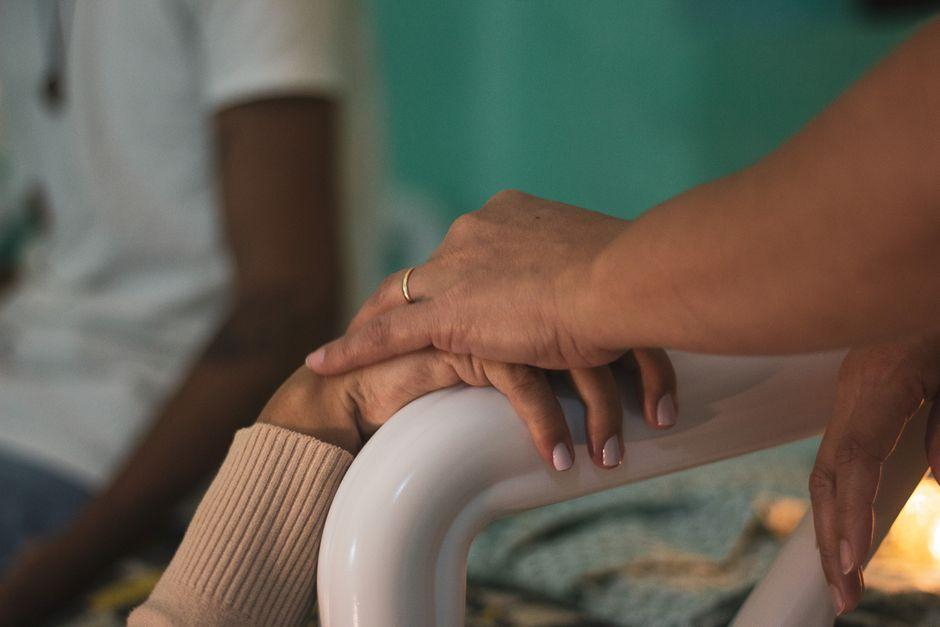
Person in a wheelchair on a cobbl

Some communities have addressed this by building a dedicated memory care neighborhood that connects directly to the main assisted living area. The cognitively intact spouse lives in the general community, but visits are easy and frequent. Meals, activities, and time together can take place in both spaces without either person having to leave.

Most families underestimate what that proximity is actually worth. Regular contact between spouses has been shown to slow emotional decline in memory care residents. It also lifts something heavy off the healthier partner: the guilt of balancing visits against their own wellbeing. When the distance is a hallway instead of a car ride, that particular weight mostly disappears.

Questions to Ask When Touring Communities

Not every community that claims to serve couples at different care levels actually has the infrastructure to do it well. Some will say yes to the question; the follow-up questions are where you find out what that yes actually means.

Ask whether both care levels can be accommodated on the same campus or within the same building. Ask how care plans get updated as needs change over time. Find out whether the community has a dedicated memory care program and what interaction between that program and the main assisted living population actually looks like in practice.

From there, ask about staffing ratios and how often care plans are formally reviewed. Ask what happens if one spouse’s needs eventually exceed what the community can manage. The last question is the one families most often skip, and it’s reliably the one that causes the hardest surprises down the road.

Staying Together Matters

The wish to stay near a lifelong partner doesn’t soften with age. For many older adults, it gets stronger. Communities that treat that as a real priority, rather than a logistical footnote, tend to operate differently, showing up across the entire experience.

Couple sitting together, discussing assisted living

Choosing where to spend those years goes well beyond care logistics. It’s a decision about what daily life actually looks like, what emotional stability means in practice, and what it costs to give that up in exchange for the right level of clinical support. The better communities have figured out you shouldn’t have to choose.

How Virtual Dietitian Services Help Families and Expand Access to Nutrition Support Across NL

0 · Jan 22, 2026 · Leave a Comment

As a mom who juggles family, meals, school runs, and everything in between, I know how hard it can be to find time for your own health—let alone make time to see a nutrition expert. For many families in Newfoundland and Labrador, that challenge gets even tougher with long travel times, limited access to professionals, and busy schedules.

That’s why I was excited to learn how virtual dietitian services are stepping in to help. These online options bring expert support right into your home, making healthy eating more manageable for everyday families like yours and mine.

Dietitian Services in NewfoundlandThe residents of Newfoundland and Labrador tend to experience substantial obstacles to nutrition support accessibility, such as geographical remoteness, the shortage of local professionals, distance to travel, time clashes, and so on, cannot enable individuals to obtain professional dietary assistance.

This is changing with virtual dietitian services which are now providing evidence-based nutrition care to residents around the province, irrespective of location and circumstance.

These telehealth solutions explicitly answer the specific healthcare issues of the province and at the same time achieve the same level of clinical efficacy as face-to-face appointments, but with the added convenience and ability to schedule pursuing their nutritional health at their own rate.

 Virtual Dietitian Services

Removing Geographic and Transportation Barriers

The geography of Newfoundland and Labrador poses some special issues with access to healthcare. There are numerous communities that are isolated, and there are few medical experts in the area.

Patients needing special nutrition care often have to travel far to obtain access to qualified dietitians, which includes gas prices, lost work hours or even school hours and the cost of organizing travel-bottlenecks that often hinder individuals to get care that they actually need. These barriers are completely removed when there is virtual dietitian services.

The consultations provided by registered dietitians are available to the residents at home, thus they do not need to travel, which is expensive and time-consuming. The availability is especially helpful to people living in rural, isolated islands, and in communities with a poor healthcare system where specialists are not available to them in the immediate vicinity.

virtual dietitian

Flexible Scheduling of Complex Lives

Face-to-face meetings demand time off of work, childcare, and scheduling around the office hours, which are practical difficulties that lead many individuals to postpone nutrition care indefinitely. Scheduling flexibility of virtual dietitian services is previously unheard of. Appointments may be made in the evening and weekend and on time that suits different work schedules and caring roles.

This flexibility raises considerably the chances of the actual access to services by people and the regular follow-up care which is essential to the success in reaching the nutritional health targets.

Providers such as JM Nutrition provide increased hours of availability, Monday through Friday 9 a.m. to 9 p.m. and Saturday 9 a.m. to 6 p.m. so residents can get the services they need based on their life requirements and not force life to fit the healthcare visit timetable.

Privacy and Comfort Enhancing Open Communication

In nutrition counseling, we need to be able to discuss sensitive issues: eating habits, body image issues, relations with food, and health battles of an individual. Most individuals are more at ease talking about these personal issues in the comfort of their own residences and not in the medical institutions.

Online visits also help to lower the stress some people feel in the doctor waiting rooms and hold more open and honest discussions on dietary issues and expectations. The result of this psychological relief is a direct correlation to the better results of the counseling since the clients are more comfortable to disclose all the information that dietitians require to design the recommendation that is really personalized.

Virtual Dietitian Service

Holistic Care in a Variety of Health Issues

One of the applications of virtual dietitians is to provide a complete range of nutrition services: chronic diseases (diabetes, cardiovascular disease, digestive disorders), weight loss, women (PCOS, menopause), special diets (plant-based diets, food intolerances), and overall health.

R.D.s carry out a comprehensive evaluation, create individualized nutrition, and offer continuous monitoring and counseling by means of periodic virtual follow-ups. This holistic approach is certain to provide residents with evidence-based care depending on their unique health-related needs and life situation.

Better Health Results with Accessibility and Consistency

Nutrition support that is available and convenient is always practiced by individuals with the professional care. The studies show that frequent contacts with a dietitian can greatly enhance the management of chronic diseases, compliance with diet therapy, and long-term changes in lifestyle.

With virtual services, more check-ins and monitoring are made possible without the obstacles that cannot assure consistency in in-person appointments, which leads to a significantly improved health outcome.

Conclusion

At the end of the day, we all want to do what’s best for our families—and that includes taking care of our health through good nutrition. Virtual dietitian services make that easier by offering professional, personalized guidance without the stress of travel or packed schedules.

The virtual dietitian services are a huge leap to the people of Newfoundland and Labrador since geographic isolation and lack of time are no longer a problem but an opportunity.

Purchasing and delivering professional nutrition advice to the homes of individuals and fitting perfectly in their lifestyles, virtual services increase the number of people that can access life-changing professional nutrition support in the whole province.

To the community members who are determined to manage their health status via nutrition or general wellness, the support of the virtual dietitians offers convenient access to evidence-based support that was not readily available to many people in the past.

Sleep Is the One Wellness Habit Moms Keep Negotiating With

0 · Jan 2, 2026 · Leave a Comment

Sleep gets talked about like it is optional, like something you earn after everything else is handled. For a lot of moms, it turns into a moving target. Kids wake up. Brains refuse to shut off. Bodies feel wired and tired at the same time. The goal is not perfection. It is consistency that feels doable in real life, even when the house is loud and the calendar is packed.

Good sleep does not start at bedtime. It starts with how the day winds down, how the body lets go of tension, and how the environment supports rest instead of fighting it. That means small choices that add up, not rigid rules that fall apart the second life gets messy.

The Wind Down Matters More Than the Wake Up

Most sleep trouble begins before anyone gets into bed. The nervous system needs a signal that the day is ending. Scrolling, answering late texts, or mentally replaying conversations does the opposite. Even ten or fifteen minutes of intentional slowing down can shift the whole night.

Warmth helps with this more than people realize. A hot shower, a heating pad on tight shoulders, or quiet stretching can tell the body it is safe to rest. Some people also notice the benefits of sauna style heat exposure in the evening, whether that is an actual sauna or simply spending time in a warm, steamy space. Heat encourages muscles to relax and can make the transition into sleep feel less abrupt. This is not about adding another task to an already long list. It is about replacing stimulation with softness. Less push, more permission to stop.

Your Bedroom Is Either Helping Or Sabotaging You

Bedrooms often turn into catch all spaces. Laundry piles up. Phones charge inches from pillows. Light sneaks in from every corner. Sleep does not love clutter or brightness. It prefers calm, dark, and cool.

White comforter and pillows on a bed

Blackout curtains, a fan for steady background noise, and keeping the room slightly cooler can make a noticeable difference. So can removing visual chaos. Even small changes like clearing the nightstand or choosing softer lighting can help the brain associate the space with rest instead of unfinished business.

Comfort matters too. Sheets that breathe, pillows that support the neck without forcing it forward, and a mattress that actually suits the body you have now, not the one you had ten years ago.

The Mattress Question No One Wants To Deal With

A bad mattress quietly ruins sleep night after night. People adapt to it without realizing how much effort their body is putting in just to stay comfortable. Waking up sore, tossing and turning, or needing multiple pillows to prop things just right are often signs the mattress is no longer doing its job.

Woman sleeping peacefully in bed

This is where trying before buying still matters. Ordering online can work, but many people need to feel support in person. When it comes to mattress stores in the San Francisco Bay area, near Nashville or anywhere in between a reputable store is a must because guidance matters. A good store does not rush the process or push the most expensive option. It helps you find something that supports sleep instead of selling a trend. Sleep quality is tied directly to physical support. That is not indulgent. It is practical.

Nighttime Anxiety Does Not Mean You Are Doing Sleep Wrong

Lying down can be the first quiet moment of the day, which is why worries tend to show up right then. This does not mean something is wrong. It means the brain finally has space to talk.

Rather than trying to force thoughts away, it can help to give them a container. Writing a few lines in a notebook, breathing slowly with a hand on the chest, or listening to something gentle and familiar can lower the volume. The goal is not empty silence. It is safe. Consistency helps here too. When the body learns that bedtime is predictable and calm, it stops bracing for impact. That takes repetition, not perfection.

Sleep Routines Should Bend Instead Of Break

Rigid routines rarely survive real family life. Flexible rhythms do. A loose sequence that stays mostly the same, even if the timing shifts, is often more effective than strict schedules that collapse the moment plans change.

This might mean dimming lights at the same point every evening, changing into comfortable clothes early, or keeping the same pre bed ritual even when bedtime runs late. The body responds to patterns, not clocks. Sleep is not something to conquer. It is something to cooperate with.

A Better Night Is Built Over Time

There is no single switch that fixes sleep. It improves when the body feels supported, the environment feels calm, and expectations feel realistic. Small changes done consistently matter more than dramatic overhauls that last a week. Moms do not need more pressure around sleep. They need systems that work even on imperfect days, and permission to rest without earning it first.

Where Rest Finally Gets Its Due

Sleep is not a luxury or a reward at the end of productivity. It is the foundation that makes everything else steadier. When nights become more restorative, days follow with more patience, clearer thinking, and a body that feels less like it is running on fumes. That kind of rest is worth protecting.

What Moms Should Know About the Hidden Causes of Back Pain and How to Find Relief

0 · Dec 30, 2025 · Leave a Comment

As moms, we’re used to carrying a lot—groceries, laundry baskets, diaper bags, and sometimes even our kids. It’s no wonder that back pain can sneak into our daily lives. But when the discomfort sticks around longer than expected, it’s easy to blame it on getting older or just being busy. The truth is, there are often hidden reasons behind that ongoing pain that many of us don’t think about.

Understanding these overlooked causes can help you take better care of your body and feel stronger for your family and yourself. Let’s look at what might really be behind your back pain and how to manage it in simple, practical ways.

back pain

1. Poor Posture in Everyday Activities

We hear a lot about posture, but not all of us pay attention to how much it impacts our backs. Most people think “posture correction” only matters when sitting at a desk. But the truth is that the way we stand, walk, and even relax on the couch all day can influence spinal alignment.

Signs your posture may be contributing to pain:

  • Rounded shoulders or forward head position.
  • Slouching while sitting or standing.
  • Leaning to one side when carrying items.
  • Curved lower back when walking or standing still.

Well, correcting posture starts with awareness. Small adjustments, such as engaging your core muscles, keeping your shoulders back, and maintaining a neutral spine, can reduce stress on your back. Moreover, ergonomic chairs, adjustable desks, and setting reminders to reset your posture throughout the day can also help.

But for many people, posture-related discomfort gradually develops into persistent back pain when muscle imbalances and alignment issues go unaddressed. In such cases, a structured evaluation helps identify how everyday habits are affecting spinal health. Moreover, reliable clinics like Physiomed focus on assessing movement patterns and posture-related strain as part of their back pain treatment approach. This, as a result, helps individuals address the root cause rather than just managing symptoms.

2. Lack of Core Strength and Support

When we think of back pain, we often focus on the spine itself—but the muscles that support it are just as important. Strong core muscles act as the body’s natural support system for the spine. When these muscles are weak or inactive, the back has to compensate, which can lead to chronic strain and discomfort.

Some of the common signs of weak core-related pain include:

  • Pain after standing or walking for extended periods.
  • Discomfort when bending or lifting.
  • Tightness in the lower back after sitting for too long.
  • Frequent reliance on painkillers to cope with everyday movement.

A targeted approach to strengthening your core—through gentle exercises like pelvic tilts, modified planks, and low-impact movements—can make a meaningful difference. Working with a physical therapist or rehabilitation specialist helps ensure you are activating the right muscles without over-straining others.

Last but not least, including mobility work and functional strength training in your routine can also improve spinal support and reduce the frequency of pain flare-ups.

Ongoing Back Pain

3. Everyday Movement Patterns and Repetitive Activities

Back pain is not always caused by a single event or injury. Sometimes, it stems from small, repeated actions that gradually strain the spine and supporting muscles. This can happen whether you have a desk job, a physically demanding routine, or a mix of both.

Think about activities like:

  • Bending repeatedly without knee support.
  • Twisting while lifting children or groceries.
  • Standing for long periods on hard surfaces.
  • Getting in and out of the car without stabilizing support.

These seemingly “normal” movements can create micro-traumas over time, especially if posture and muscle support are already compromised.

To manage this, it helps to do the following things:

  • Learn proper body mechanics for everyday tasks.
  • Break up repetitive tasks with brief mobility breaks.
  • Use supportive footwear and ergonomic tools.
  • Engage the hips and legs more, taking stress off the lower back.

All in all, small tweaks to how we move can produce big, long-term benefits and reduce cumulative strain.

To Sum It All Up!

Back pain doesn’t have to be part of your normal mom life. While it’s easy to ignore or push through it, knowing what’s really causing it can make a big difference. From posture and core strength to how we move during daily chores, small changes can lead to big relief.

By paying attention to these lesser-known causes and taking steps to care for your body, you can feel better and move through your days with more ease. Because when moms feel good, the whole family benefits.

  • Page 1
  • Page 2
  • Page 3
  • Page 4
  • Go to Next Page »

Primary Sidebar

Heather from Whipperberry
Hello... my name is Heather and I'm the creator of WhipperBerry a creative lifestyle blog packed full of great recipes and creative ideas for your home and family. I find I am happiest when I'm living a creative life and I love to share what I've been up to along the way... Come explore, my hope is that you'll leave inspired!

Footer

  • Privacy Policy
  • Crafts
  • Food
  • Gifts
  • Holidays
  • Home
  • Mom Life
  • Recipes
  • Travel

Copyright © 2026 · Seasoned Pro