• Skip to primary navigation
  • Skip to main content
  • Skip to primary sidebar
  • Skip to footer

Whipperberry

WhipperBerry • Your Home For Creative Inspiration

  • Home
  • Recipes
    • Starters
    • Easy Weeknight Dinners
    • Main Dish
    • Salads
    • Side Dish
    • Soups & Stews
    • Desserts
    • Breakfast
    • Miscellaneous
  • Tutorials
    • Creative Crafts
    • DIY Decor
    • Fabric Crafts
    • Food How-To
    • Jewlery
    • Paint Projects
    • Paper Art
    • Party Styling
    • Photography and Graphic Design
    • Silhouette
  • Holidays
    • Easter
    • Mother’s Day
    • Father’s Day
    • 4th of July
    • Halloween
    • Thanksgiving
    • Christmas
    • Valentine’s Day
  • Gift Ideas
    • Gifts For Everyone
    • Gifts for Dad
    • Mother’s day
    • For The Girls
    • For The Kids
    • Teacher Gift Ideas
    • Christmas
  • Printables
    • Holiday
    • Gift Idea
    • LDS Primary
  • Travel
  • About
    • Terms
  • Contact
  • Nav Social Menu

    • Facebook
    • Instagram
    • Pinterest
    • RSS
    • Twitter

Crafts

7 Best Arts Camps in Riverside: Where Kids Learn Real Drawing and Painting Technique

0 · Sep 25, 2026 · Leave a Comment

We share plenty of projects here at Whipperberry that kids can make right at the kitchen table. But when a child really loves to draw, paint, or build things, an art camp can give them something a home craft project can’t: time with an instructor who can help them practice and improve.

So for families searching for art camps in Riverside, we did some digging. We looked through museum programs, city recreation offerings, art schools, and summer camps in Riverside and nearby communities.

The seven programs below stood out for teaching actual art skills, including drawing, painting, color theory, composition, and sculpture. There’s a nice mix, too. You’ll find short city programs for kids who want to give art camp a try, museum classes, full-day options, and more intensive programs for serious young artists.

We’ve gathered the important details in one place so you can compare the options before checking current dates and availability with the camps themselves.

Quick Comparison of the Best Arts Camps in Riverside and Nearby
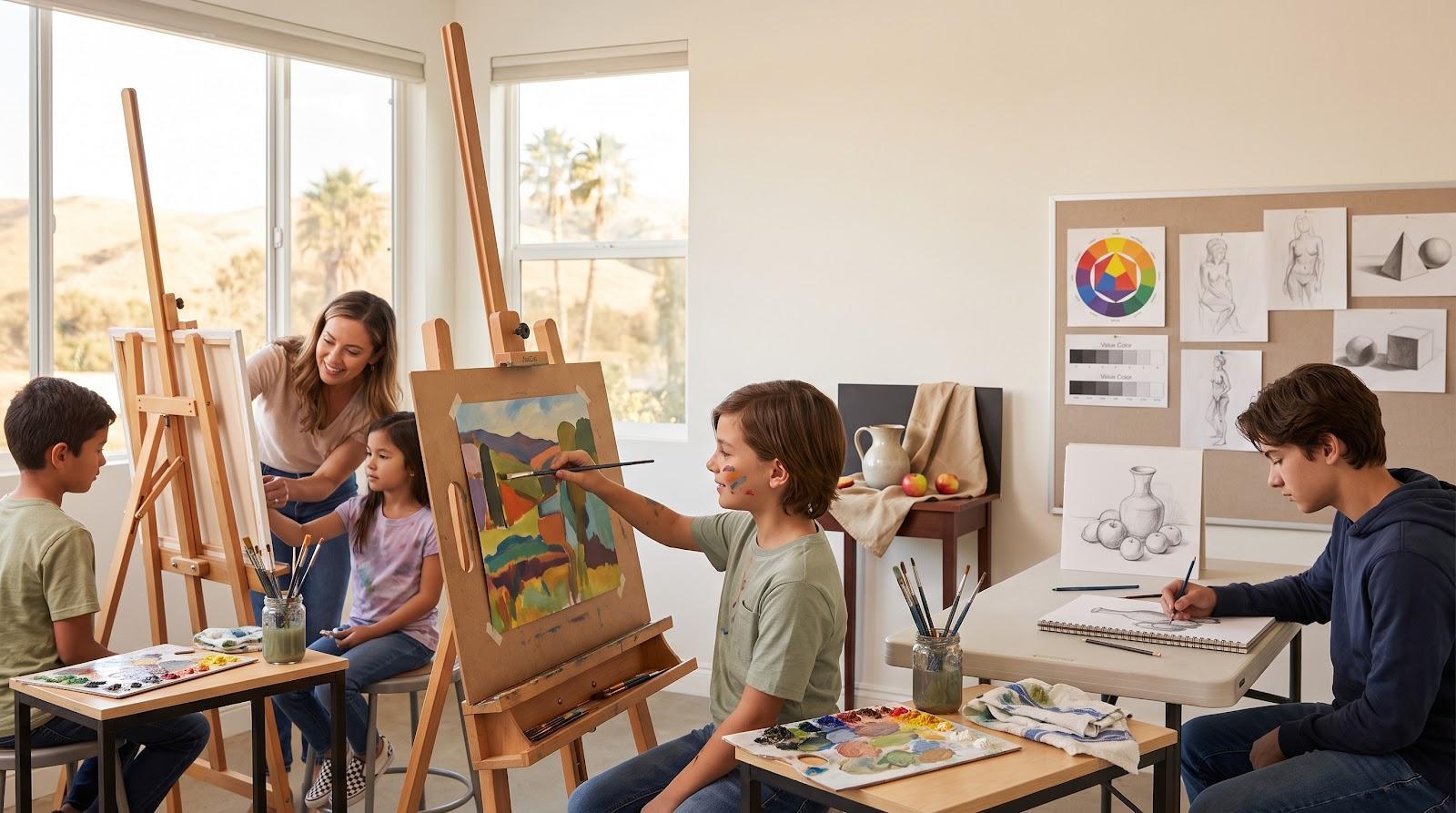
Arts Camps Where Kids Learn Real Drawing and Painting Technique

Need a quick snapshot? The table below lists each program’s city, format, core techniques, safety cues, and whether fees are posted. Use it as a reference, then explore the detailed reviews that follow.

CampCityFormatAgesTechnique focusSafety cueBest for
Pali AdventuresRunning SpringsOvernight6–16Drawing, painting, mosaic, jewelry, stained glassACA & WAIC accreditation; LiveScan & DOJ checksChoice-driven fine arts
Riverside Art Museum & The CheechRiversideHalf-day blocks5–17Drawing, painting, Procreate, street artMuseum staff supervisionIn-city museum learning
Idyllwild ArtsIdyllwildDay or residential14–17Observational drawing, oil painting, portfolio workPublished staff ratios; dorm oversightTeen intensive
StudioWorks Arts CollectiveRedlandsDay6–17Drawing, painting, dedicated watercolor weeksCity recreation background checksTechnique-focused day camp
Drawn2Art Rancho CucamongaRancho CucamongaHalf- or full-day6–17Portrait, anime, clay sculptureStudio safety policiesCharacter art & sculpture
City of Riverside Art MastersRiverside3-day session6–14Intro drawing, color theoryCity recreation staff on siteBudget-friendly intro
Fontana Arts CampFontanaFull-day7–12Painting, 2-D design, sculpture, mixed mediaMunicipal program guidelinesFull-day municipal care

Program details last verified September 2026; confirm dates, fees, and ratios with each camp before registering.
7 Best Arts Camps in Riverside, CA

How We Chose the Best Arts Camps Near Riverside

7 Best Arts Camps in Riverside, CA

What Counts as Real Art Instruction

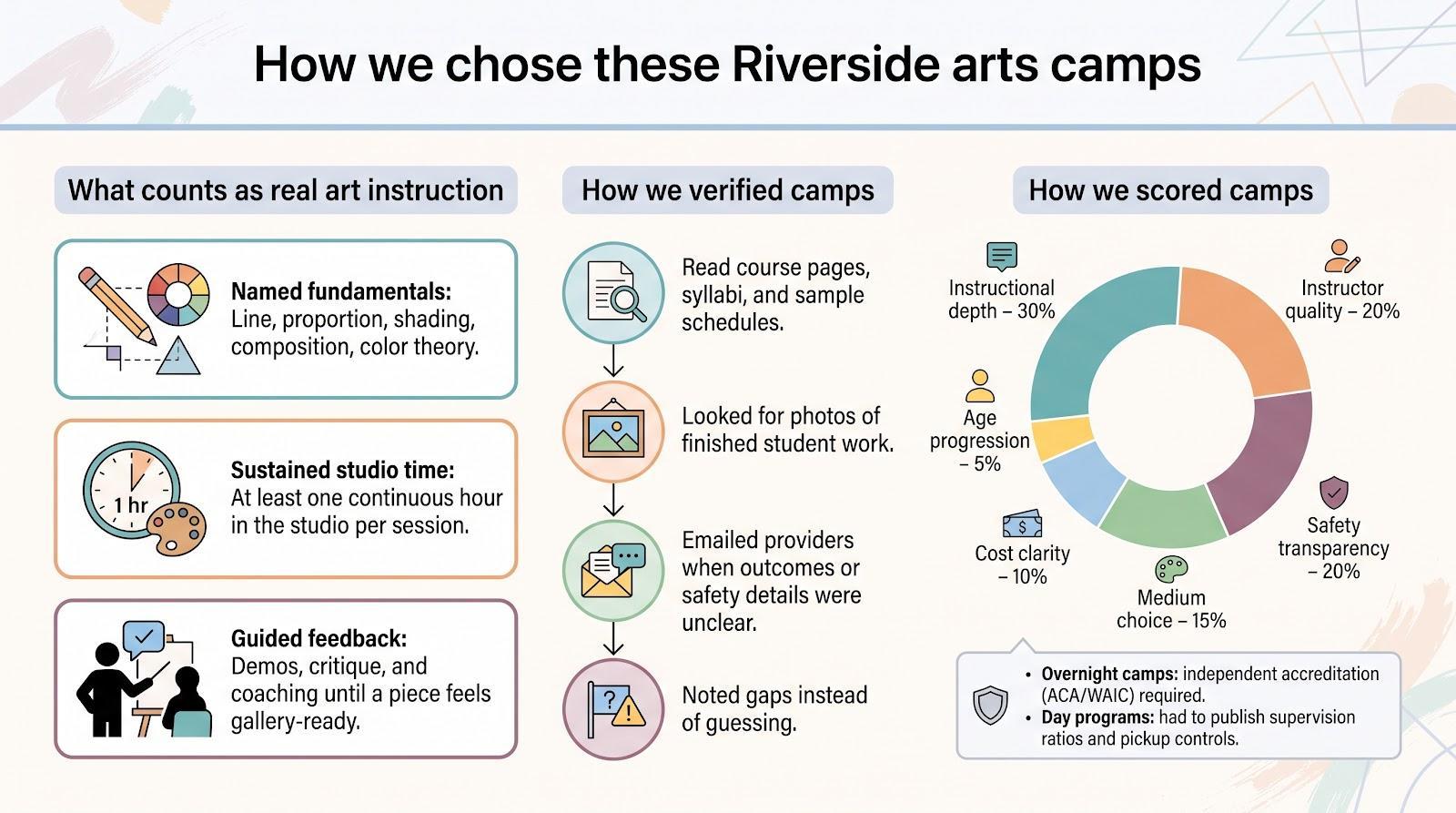
Real instruction means campers learn drawing and painting skills instead of quick glue-stick crafts. Programs had to meet three checkpoints:

  1. Named fundamentals. Course pages had to cite line, proportion, shading, composition, or color theory.
  2. Sustained studio time. Each session needed at least one continuous hour in the studio (not five-minute breaks between dodgeball games).
  3. Guided feedback. Instructors had to demo, critique, and coach students until a piece felt gallery-ready.

Our Verification Steps

We read every public syllabus, cross-checked sample schedules, and looked for photos of finished work. When a provider skimmed over learning outcomes, we emailed follow-up questions or noted the gap rather than guessing.

Weighted Criteria

Final picks scored highest across six factors: instructional depth (30 percent), instructor quality (20 percent), safety transparency (20 percent), medium choice (15 percent), cost clarity (10 percent), and age progression (5 percent). Overnight camps also needed independent accreditation evidence, while day programs had to publish clear ratios and pickup controls.

1. Pali Adventures: Best Overnight Camp for Choice-Driven Fine Arts

The fine arts camp at Pali Adventures spotlights a different medium each day such as charcoal sketching, watercolor painting, jewelry fabrication, stained glass, and mosaic, giving campers three focused morning hours to master new techniques before they dive into afternoon electives.

Why It Stands Out

Pali offers 27 specialties across three tracks: Adventure, Creative, and Performance. At the fine arts camp in Running Springs, campers spend three focused hours each morning on drawing, acrylic or watercolor painting, mosaic, jewelry making, and stained-glass design. After lunch they choose from more than 70 electives, such as a ropes course, zip lining, or water wars, so art stays central without feeling confining.

Safety and Parent Trust

Pali holds both ACA and WAIC accreditation and requires LiveScan and U.S. Department of Justice background checks for every staffer. First aid/CPR/AED-certified counselors and on-site registered nurses support a camp-wide supervision ratio better than 3:1. The Better Business Bureau lists an A+ rating (non-accredited file).

Age Fit and All-Inclusive Value

The overnight program groups campers into Mini (6–8), Junior (8–12), and Senior (13–16) paths. Pali does not publish pricing, and families must contact the camp directly, but the rate covers lodging, meals, activities, and all specialty supplies, with no surprise add-ons. Weigh the phone-free, sleep-away format and the need to request pricing against the deep morning art block and broad elective menu.

2. Riverside Art Museum & The Cheech: Best In-City Museum Program

Riverside Art Museum

What Kids Learn

Inside the galleries at 3425 Mission Inn Avenue, classes feel like working studios. Campers ages five to seventeen master confident lines in “Mastering the Line,” layer expressive brushwork in “Paint-tastic,” and shift to clay or collage without leaving the building.

Older students alternate plein-air sketching on the terrace with digital color studies in Procreate. A rotating street-art week adds stencils and lettering, showing that classical technique and urban style can share the same canvas.

Why It Made Our List

Families enjoy true drop-off convenience plus museum-quality instruction: every course description lists skills such as contour, shading, or color theory, not generic “arts and crafts.”

Weekly half-day blocks let parents pair a morning drawing class with an afternoon digital session, and a supervised lunch bridges the gap. Gallery walk-throughs between studio blocks give campers live composition examples most classrooms can’t match.

Parent Checkpoints

  • Ask whether the fee covers all supplies (RAM loans iPads for Procreate, but sketchbooks or specialty papers may cost extra).
  • Confirm that supervised lunch is available when you pair two half-day blocks.
  • Class sizes and staff screening details are not publicly posted; request ratios and background-check information before enrolling.

3. Idyllwild Arts: Best Drawing and Painting Intensive for Teens

Idyllwild Arts

What Teens Learn

Over two weeks, the Drawing & Painting Intensive (ages 14–17) covers what many school programs only skim. Mornings begin with rapid observational sketches; afternoons add proportion studies, color-mixing drills, and composition walk-throughs.

By week two, easels pivot to oil techniques: glazing, scumbling, and edge control. Each student leaves with several portfolio-ready pieces and a stronger artistic voice. Groups cap at 12, giving instructors room to demo, circle the studio, and offer one-on-one critique.

Why It Made Our List

Depth paired with duration is rare. The schedule offers ten full studio days, evening open labs, and a forested campus with newly air-conditioned dorms as of summer 2026.

Teens can attend as day campers or stay in supervised dorms, and faculty bios list working artists who exhibit, publish, or teach at universities. Tuition, room, and board are publicly posted on the program page, so parents know the full cost before applying.

Parent Checkpoints

  • Block out the calendar; the intensive runs two weeks and seats 24 students split into two groups of 12.
  • Ask whether materials fees cover stretched canvases and oil mediums, or if extra supplies are needed.
  • Residential families should confirm roommate matching, weekend supervision, and medical staffing; day families need a daily mountain drive plan.
  • Request current class ratios and safety protocols. Idyllwild is not ACA-accredited but publishes its own supervision standards.

4. StudioWorks Arts Collective: Best Technique-Focused Day Camp Near Riverside

What Kids Learn

StudioWorks in Redlands splits summer into focused weeks covering drawing, painting, and watercolor. Campers ages 6–17 master one medium at a time. Each morning starts with a mini-lesson on proportion or brush control, then moves into guided practice while instructors correct posture, grip, and stroke direction.

By day three, every student critiques and finishes a piece on stretched paper or canvas. Watercolor week adds wet-on-wet blends, dry-brush texture, and masking tricks that translate to school projects.

Why It Made Our List

Many municipal art camps squeeze drawing between dodgeball breaks. StudioWorks offers full art days inside an air-conditioned city venue. Practicing artists lead classes, and the City of Redlands posts tuition publicly, making this one of the most budget-friendly routes to multi-day, technique-heavy instruction without a mountain drive.

Parent Checkpoints

  • Verify which artist teaches your chosen week and whether materials are included or require a supply list.
  • Session caps hover around 15 but vary; request the exact ratio and ask about background checks.
  • Need extended care? Confirm whether the camp links to Redlands’ regular recreation program.
  • A separate teen session runs later in summer; ask if your high-schooler needs portfolio depth.

5. Drawn2Art Rancho Cucamonga: Best for Character Drawing and Sculpture

Drawn2Art Rancho Cucamonga

What Kids Learn

At Drawn2Art’s Rancho Cucamonga studio, campers ages 6–17 start the morning with graphite facial-proportion studies. After lunch they explore color with pastels.

The day ends in the clay room, where they turn 2-D concepts into small sculptures. Students measure angles, block shadow shapes, build wire armatures, and add expressive details, then finish the week with a concept sketch and a fired (or air-dry) 3-D figure.

Why It Made Our List

Many “character art” camps rely on quick crafts. Drawn2Art combines classical drawing with anime and fantasy themes, so students learn bone structure before armor and wings.

Sample lessons and finished pieces appear online, and families can choose half-day or full-day slots to fit swim meets or sibling schedules. Tuition is publicly posted on the registration page, making budgeting simple.

Parent Checkpoints

  • Verify the session’s year stamp; some web cards lack a date.
  • Ask for current class size, student-to-instructor ratio, and what background checks the studio conducts.
  • Confirm whether full-day campers need a second snack and if clay pieces will be kiln-fired or air-dried.
  • Anime focus draws many kids but may not suit teens building a realism portfolio; review the project plan before enrolling.

6. City of Riverside Art Masters Camp: Best Budget-Friendly Introduction

What Kids Learn

Across a concise three-day schedule, campers ages 6–14 explore essentials without the time or cost of a full week. Day one covers the color wheel and simple mixing to show how warm and cool hues shift mood.

Day two moves into basic drawing: fluid lines, shape blocking, and light shadow. Day three spotlights a master painter; students recreate a small work using the techniques they practiced, finishing with a take-home piece that shows real progress.

Why It Made Our List

Few programs post every fee upfront, but Art Masters lists tuition and the small materials charge on the city’s ActiveKids page. Classes meet at a familiar recreation center in Riverside, sparing families a long commute. For children trying formal art lessons for the first time, the short format keeps both risk and price low.

Parent Checkpoints

  • Materials cost extra; confirm whether brushes and paper are supplied or if kids need a personal kit.
  • Ask about staff-to-student ratio and background-check policy; the city program follows municipal standards but doesn’t publish exact numbers.
  • Sessions fill quickly once summer calendars land on fridges, so book early and review the refund window.
  • A three-day intro builds basics but may not satisfy kids seeking deeper technique; consider a week-long camp if your young artist wants more studio time.

7. Fontana Arts Camp: Best Full-Day Municipal Option

What Kids Learn

At the Art Depot, campers ages 7–12 rotate through painting, two-dimensional design, sculpture, and media experiments from 9 a.m.–5 p.m. Mornings focus on drawing basics and color mixing. Afternoons pivot to projects such as papier-mâché masks or recycled-material sculptures. The daily mix keeps projects fresh while still building core technique.

Why It Made Our List

Working parents need coverage as much as curriculum, and Fontana offers both. Tuition is publicly posted on the city site, lunch is included, and staffing follows municipal background-check rules.

The itinerary feels like a mini art school. One day features texture layering with acrylics; the next, additive sculpture; then a short photography session to document finished work. Kids sample several media without leaving the Inland Empire.

Parent Checkpoints

  • Review the current itinerary; disciplines can shift each summer.
  • Ask whether non-resident pricing applies to your address and confirm allergy options on the lunch menu.
  • Request class size, instructor credentials, and student-to-staff ratio; these details are not posted online.
  • Broad rotations suit explorers; children seeking a week of pure drawing may prefer a single-medium camp.

Conclusion

The best choice really comes down to your child. Some kids want to spend all week improving their drawing, while others would rather try painting one day, sculpture the next, and something completely new after that.

Riverside families have both kinds of options on this list, along with a few programs that are worth considering if you don’t mind driving outside the city. Before you sign up, check the camp’s current schedule, prices, supply list, and supervision policies since those details can change from one summer to the next.

Then make a little room on the fridge. Chances are, at least a few new masterpieces will be coming home.


5 Simple Ways to Create a Healthier and Cozier Bedroom

0 · Sep 25, 2026 · Leave a Comment

Just for a moment, let’s be totally honest: with the time it takes to look after our family’s schedules, the endless pile of laundry to deal with, and the constant need to keep the main parts of the house in order, our own bedrooms tend to be forgotten about. It’s very easy for the master bedroom to turn into a place where unfolded clothes, books that have only just been started, and all sorts of other household items are stored.

Your bedroom shouldn’t be just the room where you end your exhausting day by collapsing into bed. It should act as your personal sanctuary, a calm and comfortable setting that enables you to recharge both physically and mentally. The good news is you don’t need a huge remodeling budget or a professional interior designer to change your room’s atmosphere completely.

If you make a few thoughtful changes to your surroundings, you can greatly improve your room’s comfort. Here are five easy, practical ways to make your bedroom healthier and cozier today.

1. Clear the Clutter for a Calmer Space

Have you ever realized how difficult it is to wind down when there’s a mess all around? Visual clutter can sometimes create a sense of restlessness. It can be harder to relax when the last thing you see before bed is a heap of laundry on ‘that one chair’ or a nightstand filled with kids’ receipts and chive toys.

Begin with the obvious surfaces; you don’t need to go through the entire closet in one weekend, but simply clearing the nightstands and dressers will make at once. Buy a couple of nice woven baskets or fabric storage bins since they are ideal for temporarily storing things that don’t have a fixed place and for keeping them out of sight.

Woman relaxing in bed next to a humidifier

Here’s a quick tip: observe the ‘five-minute sweep’ rule by taking five minutes before you brush your teeth to collect up any loose items. This simple habit means that you’ll find your space cleaner in the morning.

2. Improve the Air Quality

We spend a large part of our lives in our bedrooms, even though the quality of the indoor air is usually neglected. A well-maintained bedroom can still have airborne particles from dust, pollen, pet dander, and other sources inside the house. For people sensitive to these allergens and particles, they can worsen symptoms and make it harder to sleep comfortably.

All good initial steps include opening windows when the weather allows, keeping the bedding of pets clean, and vacuuming regularly. Moreover, one way of reducing the amount of airborne particles that stay in the room is to use air purifiers. These purifiers run in the background and capture microscopic particles, which can be especially beneficial for people sensitive to dust, pollen, or pet dander.

3. Keep Indoor Humidity Comfortable

Indoor humidity levels can vary a great deal depending on the season, since cold outdoor air usually has less moisture in it and when it is brought indoors and then heated in the winter the relative humidity decreases. In a similar way, air conditioning can also reduce the humidity level inside buildings since cooling systems tend to remove moisture from the air as they work.

Low indoor humidity can lead to dry skin, dry lips, and dry nasal passages and thus make the room less comfortable to be in at night. One simple solution to this problem is to put some moisture back into the environment. A quiet humidifier can add moisture to dry indoor air and so may make the bedroom more comfortable when the humidity levels are low.

It’s important to remember that higher humidity isn’t always preferable, since maintaining moderate levels can help prevent excess moisture and condensation. Additionally, some people find the continuous background noise of a humidifier less distracting than the occasional noises coming from outside.

4. Choose Breathable Bedding

The bed is the central feature of the room and the items placed on it are very important. A great many people have difficulty in regulating their body temperature at night, and the materials you use for bedding can have an effect. While some synthetic bedding may feel warmer or less breathable than some natural fabrics, comfort will differ depending on the material, the weave, and the way it is constructed.

If you want your bed to seem more appealing, then you should replace fabrics that don’t breathe with natural ones; cotton and linen are commonly used for bedding because they are breathable, and some fabrics derived from bamboo can also feel smooth and comfortable for people who sleep in warm conditions.

Layering is just as important for creating a cozy bed; instead of using a single thick comforter, use a breathable duvet with a thick knit throw blanket at the foot of the bed. This arrangement doesn’t only give a very appealing and fashionable appearance but also enables you to easily regulate your temperature during the night.

5. Soften the Lighting

The lighting in your bedroom has a great influence on your body’s natural circadian rhythm; exposure to bright light in the evening can cause the body to feel awake and at the same time suppress or delay the normal increase in melatonin.

In order to achieve a pleasant and relaxing atmosphere, you should soften the lighting. At least one hour before you intend to go to bed, switch off the ‘main light’. Instead, use bedside lamps. Bulbs with a colour temperature of about 2700K or other warm colour temperatures will produce a softer evening atmosphere.

You should also consider improving your window coverings; attractive blackout curtains can help cut down on light from streetlights or the early morning sun and make your room feel warmer and more suitable for rest.

Final Thoughts

You don’t need a complicated setup to have a healthier bedroom; minor adjustments to the clutter, air quality, humidity, bedding, and lighting can make the room seem more comfortable and purposeful.

What about yourself? Do you have any particular nighttime routines, or favorite tips for making your bedroom feel especially cozy? Please let me know in the comments section below—I’m always on the lookout for new ideas to try!

How to Plan a Home Remodel While Your Family Still Lives There

0 · Sep 25, 2026 · Leave a Comment

Home remodeling is an exciting process for every homeowner. But if you are planning a remodeling project in the home you are currently living in, the process is going to be challenging. Dust, noise, limited access to rooms, unexpected delays, and workers continuously coming and going can disrupt the peace and routine at home.

The good news is that you don’t have to move out while the home remodeling process is taking place. Planning a whole-home remodeling project through expert guidance can ensure that your family stays comfortable and safe while the work gets done. In the article below, we will look at how you should plan a home remodeling project while your family still lives there.

Decide the Area Where Your Family Can Live

Before the construction begins, you must identify the areas where your family can live comfortably. For example, if you have a small family, a bedroom, a place to prepare food, and a bathroom are important.

If you are planning to remodel the kitchen, you can set up a temporary kitchen in another room. A microwave, a small refrigerator, and an electric stove are enough to prepare most of the daily meals. On the other hand, if you are remodeling the bathroom, make sure that another bathroom in the house is available for use. It is important to discuss the overall construction schedule with your contractor to understand exactly when a certain room will be unavailable for use.

Create a Temporary Living Plan

You may have to change your lifestyle while the remodeling project is underway. For example, if you prefer to spend quality time alone after work, you may have to compromise, as the spaces around the house are going to be congested. Simple home refresh hacks may help you keep the area you are currently living in comfortable, but a home remodeling project is definitely going to impact your daily lifestyle. Now, if you absolutely crave some alone time after work, you can also create a “remodel-free zone,” which can be a room or area that is free from noise, dust, and activity.

Protect Your Precious Belongings

Construction dust can ruin your furniture, electronics, artwork, clothing, and other valuables. Hence, it is important to keep them away from the work area. If you can’t move them, ensure that they are properly covered. You can use plastic sheeting to cover your belongings. Along with this, you can seal the doorways or add temporary walls to separate the construction area from the other living spaces. Remember that protecting your precious belongings doesn’t only mean the expensive ones. It also includes items that are close to your heart and have sentimental value.

Also, before your contractor starts the project, ask them about the dust control measures that they plan to implement in your home to protect it from dust. Dust can cause serious health issues and allergies. Protecting your home and family from dust will help safeguard their well-being.

Plan the Remodeling Around Your Family’s Schedule

Construction is difficult when you have your family living with you. If you work from home, attend online classes, or have young children, quiet time can sometimes be a non-negotiable. Moreover, if you have an important meeting or event, you may want to discuss your schedule with the contractor. So, when you know that a particular construction activity will most likely create a lot of noise, ask your contractor to delay it so that you can complete your tasks.

Kitchen with white cabinets and wood floors

Make Safety the Top Priority

A construction site will have different tools, electrical equipment, sharp materials, exposed wiring, nails, dust, and uneven surfaces. Children and pets should never have unrestricted access to these work areas. Keep construction zones physically separated whenever possible, and make sure tools and hazardous materials are secured when workers leave.

Ask your contractor how they will handle temporary electrical connections, open walls, debris, and other potential hazards. Don’t assume that a site is safe simply because the workers are gone.

Conclusion

Living at home during a remodel is not easy. You need careful preparation to make the experience more manageable. Consider where you can live temporarily, protect your belongings, and establish clear expectations.

Remember that the disruptions are temporary. But with a clear strategy and open communication, you will be able to enhance the functionality and curb appeal of your home.

A Practical Guide to Making Plant-Based Milk at Home: Methods, Equipment, and Safety

0 · Sep 22, 2026 · Leave a Comment

Plant-based milk is a beverage made by blending nuts, seeds, grains, or legumes with water, then usually straining out the solids. People come to making plant-based milk at home for all sorts of reasons—wanting control over ingredients, chasing a particular taste, managing dietary restrictions, or simply trying to cut down on packaging waste.

The process itself can be as basic as a blender and a strainer, or as hands-off as a dedicated appliance does the work for you. Whether you stick with a simple blender-and-strainer setup or invest in a milk maker machine, making your own plant-based milk puts you in charge of ingredients, texture, and flavor in a way store-bought cartons rarely allow.

This guide covers methods, equipment, ingredient choices, and safety considerations for beginners and seasoned home cooks alike.

Key Takeaway: Homemade plant-based milk is flexible, but the method and equipment you choose will shape texture, flavor, and how convenient the whole process feels.

Plant-Based Milk

Understanding Plant-Based Milk: Ingredients and Basics

Almond, oat, soy, cashew, coconut, and hemp are the usual suspects when it comes to plant milk bases. Most recipes fall somewhere in an ingredient-to-water ratio of 1:3 to 1:5—one cup of almonds to three or four cups of water works as a reasonable starting point. Nudge that ratio up or down and you’ll notice real differences in creaminess and how intense the flavor comes through.

Extras like salt, dates, or vanilla can round out the taste, though they tend to shorten how long the milk stays fresh. Nutritionally, these bases aren’t interchangeable either: soy leans protein-heavy, while oats bring more carbohydrates to the table.

  • Almonds: mild, slightly nutty
  • Oats: neutral, quick to prepare
  • Soy: protein-rich, versatile for cooking
  • Cashews: naturally creamy, blends smooth

Methods for Making Plant-Based Milk at Home

At its core, the process is soak (if needed), blend with water, then strain through a nut milk bag or fine mesh sieve. Oats usually skip the soaking step entirely, while soybeans often need cooking after blending to make them safe and palatable.

Some people swear by a dedicated milk maker appliance for the sake of consistency and convenience; others are perfectly happy using a blender and strainer they already own.

Each path has its trade-offs—machines cut down on time and mess but take up counter space and come with a bit of a learning curve, while manual methods stay flexible and cheap but ask more of your time and attention.

Key Takeaway: Pick whichever method suits your kitchen, schedule, and patience level—good results come down to technique far more than how much you spent on equipment.

Choosing Ingredients Wisely: Nutrition, Taste, and Tolerances

Matching your base to your goals makes a real difference: reach for soy or pea milk if protein matters most, cashew or coconut for richness, oats or rice when you want something neutral enough to disappear into a recipe.

It’s also worth factoring in allergies, gluten sensitivity, and how much sugar you’re comfortable with. One of the clearest advantages of going homemade is ingredient transparency—many store-bought versions rely on stabilizers or added sugars that a homemade batch can simply do without.

Equipment Considerations: What You Really Need

Essential equipment boils down to a blender, something to strain with, and containers for storage. Optional equipment—funnels, measuring cups, specialized machines—adds convenience, but none of it is strictly necessary for a good result.

  • Must-have: blender, strainer, glass storage jars
  • Nice-to-have: dedicated milk-making appliance, funnel

Key Takeaway: Start with what’s already in your kitchen, and only upgrade once homemade milk earns a permanent spot in your routine.

Safety, Storage, and Quality: Doing It Right

Good food safety habits here are simple but non-negotiable: wash your equipment thoroughly, get the milk into the fridge promptly, and drink it within a few days. Keep an eye out for signs of spoilage—a sour smell, mold, or clumping that goes beyond the gentle separation that’s normal for these milks. If the texture turns grainy, blending longer or straining more finely usually solves it; oat milk that comes out slimy tends to improve with colder water and a shorter blend time.

Practical Examples and Everyday Use

Plenty of people settle into a weekly rhythm—oat milk for the morning coffee, almond milk blended into smoothies, soy milk reserved for cooking. Homemade milk doesn’t always behave exactly like the store-bought version, so it pays to experiment and adjust rather than expect a perfect match right out of the gate.

  • Coffee and tea
  • Smoothies
  • Baking
  • Sauces

Bringing It All Together

Homemade plant-based milk gives you flexibility and control, but getting it right depends on careful technique and proper storage. The best plant-based milk is the one you can make safely, enjoy consistently, and adapt to your needs. With a bit of practice, small tweaks to ratio, soak time, or straining method will get you to results that fit your taste and your routine.

Gift Ideas That Feel Personal, Memorable, and Actually Worth Keeping

0 · Sep 22, 2026 · Leave a Comment

Finding the right gift can be surprisingly hard. I want to give something that shows I put some thought into it, especially for birthdays, holidays, weddings, and housewarmings. I also don’t want to add one more thing to someone’s home that they don’t really need.

I’ve found that the gifts people keep are usually tied to something they already love. It could be a handmade gift for a friend who appreciates DIY projects, a pretty piece for someone’s home, or a keepsake connected to a family memory. Even a practical gift can feel special when you choose it with that person in mind.

So instead of starting with a long list of popular gift ideas, think about the person first. Pay attention to what they use, what they collect, and what makes their home feel like theirs. That’s usually where the best gift ideas begin.

Gift Ideas That Feel Personal

Source: Pexels

Start With How the Person Lives, Not Just What They Like

A lot of gift shopping goes sideways because you focus too much on broad interests. Someone may love music, coffee, or travel, but that doesn’t automatically point to a good gift. What matters more is how that interest shows up in their daily life.

If your friend loves coffee, do they make pour-over every morning or grab whatever is closest on the way to class? If your aunt enjoys gardening, is she growing roses with military precision or keeping a few herbs alive on the windowsill? Those details change everything.

Useful gifts often come from observation:

  • What do they do every week without fail?
  • What do they complain about replacing?
  • What do they keep organized, displayed, or talked about often?
  • What hobby have they quietly invested in over time?

A strong gift feels less like a random pick and more like proof that you pay attention.

Choose Gifts With a Story Behind Them

Some presents stand out because they come with a built-in story. That story might relate to family history, travel, craftsmanship, or a shared memory. People tend to hold onto gifts longer when the item means more than its price tag.

Collectors’ pieces work especially well here, since they often bring history and personality into one object. For someone who enjoys decorative keepsakes, heirloom-style gifts, or finely crafted collectibles, French Limoges boxes can be a thoughtful option. They’re hand-painted porcelain trinket boxes with roots in French craftsmanship, and they often feature detailed themes like flowers, animals, landmarks, or holiday motifs.

That level of detail gives you room to match the gift to the person. Choosing a flower they grow in their garden, an animal they love, or a place they’ve visited can make a small keepsake feel much more personal.

Practical Gifts Work Better When They Feel Upgraded

Practical gifts get dismissed too quickly, mostly because people confuse useful with boring. The real issue usually isn’t practicality. It’s lack of care. A plain phone charger feels forgettable. A high-quality charging station that solves someone’s actual desk mess feels smart.

One easy approach is to choose a better version of something they already use. Think about the difference between basic and considered:

  • A standard notebook vs. a durable journal with thick paper
  • Cheap kitchen tools vs. a well-balanced chef’s knife
  • Generic candles vs. a scent that matches their home style
  • Random tote bag vs. one that fits work, gym, and errands

This approach works because you’re improving their routine instead of adding clutter. Sometimes the most appreciated gift is simply a nicer version of something they reach for all the time.

Match the Gift to the Relationship

Not every good gift is right for every person. Your relationship with someone sets the tone. A gift for a close friend can be more personal and specific. A gift for a coworker, neighbor, or in-law usually needs a little more neutral ground.

For close relationships, you can lean into inside jokes, shared experiences, or deeply specific interests. For broader circles, aim for quality and thoughtfulness without crossing into overly intimate territory.

A few reliable categories include:

  • Food and drink items with strong presentation
  • Home pieces that suit many styles
  • Hobby accessories that aren’t too specialized
  • Small luxury items people might not buy for themselves
  • Keepsakes connected to major milestones

This matters during birthdays, graduations, housewarmings, and weddings, where the wrong level of familiarity can feel awkward. The goal is to choose something that feels thoughtful without making the gift more personal than the relationship calls for.

Think Beyond the Moment They Open It

It’s easy to focus on the moment someone opens a gift, but I also like to think about what happens to it afterward. Some presents create a big reaction right away but fade fast. Others grow more meaningful because they become part of someone’s home, habits, or memories.

Before buying anything, picture where it goes next. Will it be used weekly? Displayed on a shelf? Packed away? Thinking about where the gift will end up can quickly tell you whether it’s something they’ll really enjoy.

A few things can make a gift easier to enjoy for years:

  • Durability
  • Emotional meaning
  • Aesthetic appeal
  • Seasonal tradition
  • Personal relevance

A holiday ornament tied to a memory may come out every year. A well-made box for letters or jewelry may stay on a dresser for decades. Even small objects can have staying power when they fit naturally into a person’s space and routines.

The best gifts are often the ones people continue to use, display, or bring out year after year.

Presentation Matters More Than People Pretend

You don’t need luxury wrapping or perfectly tied bows, but presentation shapes how the gift is received. Even simple wrapping can show that you took a little extra time with the gift. A thoughtful presentation can make a simple gift feel elevated, while poor presentation can flatten something genuinely great.

Keep it clean and intentional. Use wrapping that fits the occasion and the person’s style. Add a short handwritten note if the gift has a story or specific reason behind it. That note often becomes the part people remember.

Good presentation can include:

  • Wrapping that feels neat, not rushed
  • A handmade gift tag or a little ribbon
  • A card with a real message instead of just a signature
  • Packaging that protects delicate or collectible items properly

If you like DIY projects, this is also an easy place to get creative. Try stamped kraft paper, handmade tags, dried greenery, or even wrapping paper decorated by the kids. You don’t have to make the gift itself to give it a homemade touch.

Make It Personal

If you want to give better gifts consistently, stop searching for universally perfect ideas. Those rarely exist. Better results come from being specific about the person, the occasion, and what they might actually do with the gift once they get home.

Ask yourself a few direct questions:

  • What part of their personality is easy to overlook but important?
  • What object would fit naturally into their space or routine?
  • What would feel thoughtful without feeling excessive?
  • What kind of gift would they keep, use, or remember next year?

I find questions like these much more helpful than scrolling through endless gift guides. You don’t need a huge budget or dozens of choices. Paying attention to the little things can lead you to something far more meaningful.

A memorable gift usually isn’t the biggest one in the room. It’s often the one that makes the person smile and say, “You remembered.”

Give Something They’ll Want to Keep

After all the searching, I think choosing a memorable gift comes down to knowing the person. Think about what they enjoy doing on a Saturday afternoon, what they have displayed around their home, or the family stories they love to tell. Those clues are often more helpful than another list of this year’s must-have gifts.

And it doesn’t have to be expensive. I’m a big believer in the little extras, too. Wrap it nicely, make a gift tag, or tuck a handwritten note inside. If you enjoy crafting, this is an easy place to add something handmade without making the entire gift yourself.

Years from now, no one is going to remember how trendy a gift was when you bought it. But they may still have that ornament on the tree, that little box on their dresser, or that handmade tag tucked away with other keepsakes. For me, that’s what makes a gift worth giving.

  • « Go to Previous Page
  • Page 1
  • Interim pages omitted …
  • Page 11
  • Page 12
  • Page 13
  • Page 14
  • Page 15
  • Interim pages omitted …
  • Page 518
  • Go to Next Page »

Primary Sidebar

Heather from Whipperberry
Hello... my name is Heather and I'm the creator of WhipperBerry a creative lifestyle blog packed full of great recipes and creative ideas for your home and family. I find I am happiest when I'm living a creative life and I love to share what I've been up to along the way... Come explore, my hope is that you'll leave inspired!

Footer

  • Privacy Policy
  • Crafts
  • Food
  • Gifts
  • Holidays
  • Home
  • Mom Life
  • Recipes
  • Travel

Copyright © 2026 · Seasoned Pro